Quantum Bits is intended to introduce quantum computing terms in a fun and accessible way. It is a personal project of Yuval Boger, whose day job is Chief Commercial Officer at QuEra Computing. You might also know Yuval from his Superposition Guy's Podcast series (listen here)

Subscribe on Substack at https://qubitguy.substack.com/ to get both comics and podcasts.


Latest Posts

Quantum Simulation

A quantum comic strip about quantum simulation

In 1981, physicist Richard Feynman pointed out a fundamental mismatch in computer science. Nature is inherently quantum mechanical, but the computers we use to model it are strictly classical. He proposed a direct solution. If you want to make an accurate simulation of nature, you should make the computer itself out of quantum mechanical elements. This observation became the original motivation for building a quantum computer.

Simulating chemical reactions or novel materials on a classical machine hits a wall very quickly. Every time you add an electron to an exact molecular model, the mathematical space required to track all possible quantum states and interactions grows exponentially. The largest classical supercomputers run out of memory trying to exactly model a cluster of just a few dozen atoms. To study anything larger, scientists must rely on heavy mathematical approximations.

Quantum simulation bypasses this scaling problem by using qubits to directly represent the electrons and atoms of the target system. Because the qubits operate under the same rules of quantum mechanics as the molecule being studied, they naturally capture the complexity without needing to store astronomical amounts of data. The quantum computer uses its own physical state to map the underlying physics of the target molecule. Setting up this mapping still requires careful algorithmic choices about which molecular properties to represent and how to encode them onto qubits, but the fundamental scaling advantage holds.

The primary goal is resolving open questions in chemistry and physics that strictly resist classical modeling. Mapping the exact catalyst reactions required to efficiently produce synthetic fertilizer or understanding the mechanics behind high temperature superconductors requires perfect quantum-level detail. Cheaper fertilizer production alone could reshape global agriculture, and room-temperature superconductors would transform energy transmission and computing hardware. By building controllable laboratory systems that map directly to these phenomena, researchers gain a practical way to study the quantum world on its own terms.

Subscribe on Substack at https://qubitguy.substack.com/
Quantum Speedup

A quantum comic strip about quantum speedup

Quantum computing is not a faster version of classical computing. If you could run a standard word processor or web browser on a quantum machine, it would likely run slower than it does on your smartphone. The concept of quantum speedup refers to a completely different mathematical approach to solving highly specific, complex problems. It is not about increasing processor clock speeds, but rather about radically reducing the total number of computational steps required to reach an answer.

A common misconception is that a quantum computer achieves this speedup by trying every possible answer simultaneously. In reality, it works more like a carefully choreographed wave pool. A quantum algorithm assigns mathematical weights called amplitudes to different computational paths. Through a process called quantum interference, the algorithm suppresses wrong answers and amplifies correct ones. The speedup comes from this ability to manipulate probabilities to reinforce the right solution in far fewer steps than a classical machine would need to check all the options.

Because this mechanism relies on the mathematical structure of the problem itself, quantum speedup only applies to certain classes of tasks. Computer scientists divide these advantages into different categories. A polynomial speedup, like the one offered by Grover’s algorithm for searching unstructured data, turns a problem that scales terribly into one that scales more manageably. An exponential speedup, like Shor’s algorithm for factoring large numbers or algorithms for simulating quantum mechanics, is much more profound. It transforms a calculation that would take a classical supercomputer millions of years into one that a future quantum machine could solve in days or hours.

Achieving these theoretical speedups in the physical world requires large-scale, fault-tolerant hardware, yet today’s quantum processors are limited in the number of qubits and prone to errors.

Subscribe on Substack at https://qubitguy.substack.com/
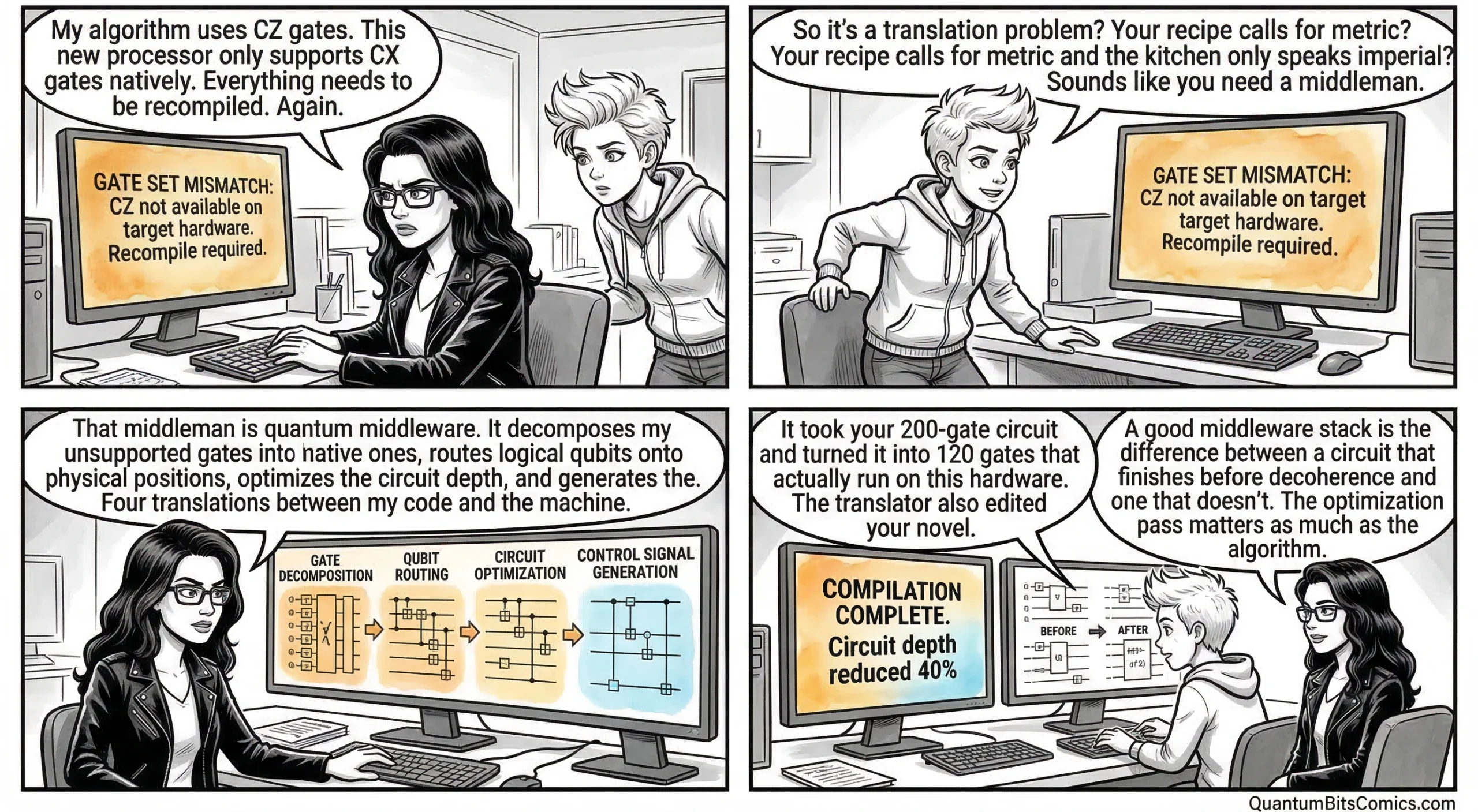
Quantum Sensing

A quantum comic strip about quantum sensing

The same fragility that makes quantum computing so difficult to build makes quantum systems extraordinarily useful as sensors. A qubit is sensitive to everything around it: magnetic fields, electric fields, temperature, pressure, gravity, rotation. In a quantum computer, this sensitivity is a problem to be engineered away. In a quantum sensor, it is the entire point.

The basic principle is straightforward. You prepare a quantum particle in a superposition. When this particle encounters the field you want to measure, the field causes the different parts of the superposition to evolve at slightly different rates, like two clocks ticking at different speeds. When you measure the particle, you can determine how much the clocks went out of sync, which tells you exactly how strong the field was.

What makes quantum sensors special is their precision. By using entangled particles, sensors can achieve sensitivity beyond what’s possible with classical devices. With regular sensors, doubling your number of detectors makes measurements about 40% more precise. With entangled quantum sensors, doubling your detectors can double your precision, a scaling advantage that compounds as sensor arrays grow larger.

Practical quantum sensors are already in use. Atomic clocks that synchronize GPS satellites measure time by tracking the vibrations of cesium atoms. Doctors use quantum sensors to detect the tiny magnetic fields produced by brain activity. Geologists use quantum gravity sensors to find underground structures by detecting minute variations in gravitational pull. The underlying hardware varies: some sensors use clouds of ultra-cold atoms, others use nitrogen-vacancy defects in diamond crystals, and still others use vapor cells filled with rubidium gas.

Quantum sensing is arguably the most mature commercial application of quantum technology. While quantum computers remain experimental and quantum communication networks are just beginning deployment, quantum sensors are already at work in hospitals, research labs, and even in outer space. Their impact will only grow as they become smaller, cheaper, and more sensitive.

Subscribe on Substack at https://qubitguy.substack.com/
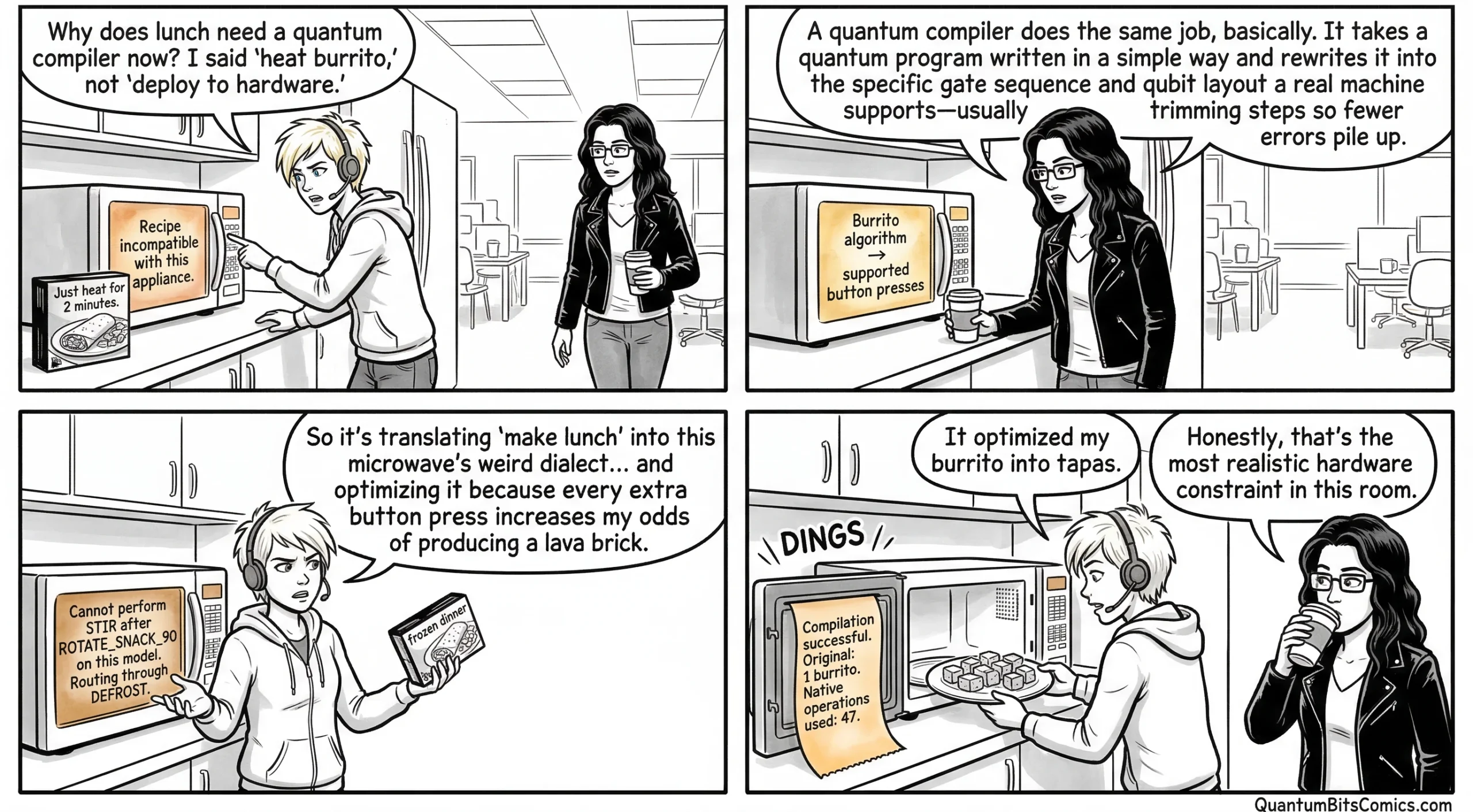
Qiskit

A quantum comic strip about qiskit

Qiskit is an open-source quantum software development kit created by IBM. It is the most widely used framework for writing, compiling, and executing quantum programs, and it has become the default entry point for much of the quantum computing community.

Developers write quantum programs in Python using Qiskit’s circuit-building tools. A typical workflow involves constructing a quantum circuit by specifying gates and measurements, transpiling that circuit for a specific backend (which handles gate decomposition, qubit routing, and optimization), and then executing it on either a classical simulator or real quantum hardware accessible through IBM’s cloud platform.

Qiskit is organized into modular components. The core library handles circuit construction and transpilation. Qiskit Runtime provides an optimized execution environment for hybrid algorithms, managing the quantum-classical loop with reduced latency. Separate modules support specific application domains including quantum chemistry, optimization, and machine learning.

The framework also serves as an educational on-ramp. Because Qiskit runs on any laptop with Python installed and provides access to real quantum processors through the cloud, it allows researchers, students, and developers to gain practical experience with quantum programming on current hardware. This matters strategically: when more capable hardware arrives, the community of practitioners, algorithms, and tooling built around frameworks like Qiskit will determine how quickly quantum computing delivers practical value.

Subscribe on Substack at https://qubitguy.substack.com/
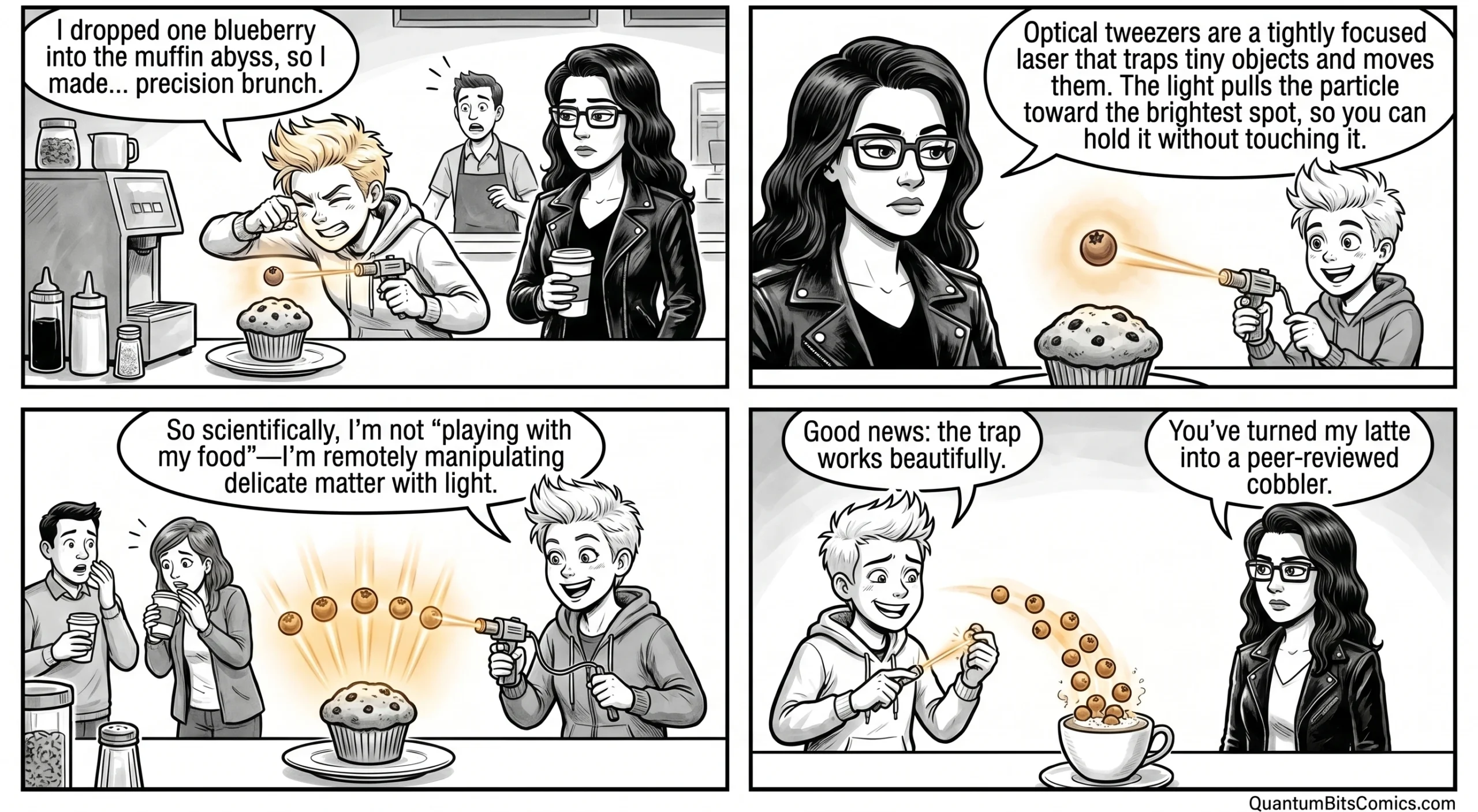
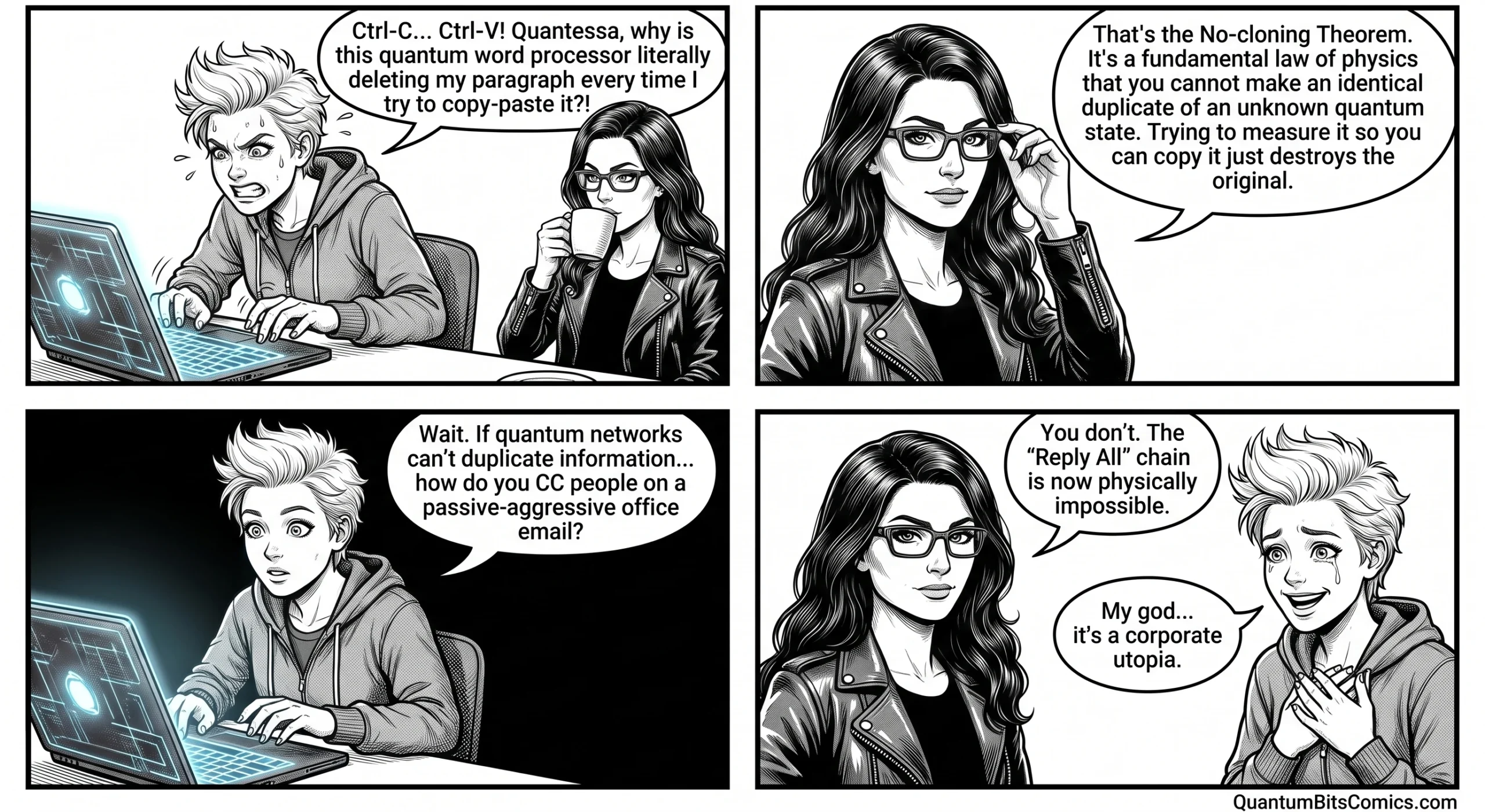
Surface Codes

A quantum comic strip about surface codes

The surface code is the most widely studied quantum error correction scheme, and for good reason: it has a high error threshold (approximately 1% for standard noise models), meaning it can tolerate relatively noisy physical qubits compared to other codes. Its structure maps naturally onto the two-dimensional grid layouts that many quantum hardware platforms already use.

The basic idea: arrange physical qubits in a two-dimensional grid. Some qubits store the actual computation (data qubits). Others exist solely to detect errors (ancilla qubits, sometimes called “syndrome” qubits). Each ancilla qubit interacts only with its immediate neighbors, measuring a collective property that reveals whether a nearby error has occurred, without revealing the actual quantum information being protected.

This indirect detection is essential. Quantum mechanics forbids copying an unknown quantum state (the no-cloning theorem), and directly measuring a data qubit would destroy its quantum information. The ancilla qubits sidestep this by checking for consistency between neighbors rather than reading the data itself.

When an error does occur, it shows up as a pattern of unexpected measurements across multiple ancilla qubits. A classical decoding algorithm analyzes this pattern and determines the most likely error, allowing the system to correct it. The process runs continuously during computation.

A key parameter is the code distance, which determines how many errors the code can correct. A distance-d surface code can correct up to (d-1)/2 errors. Increasing the code distance requires a larger grid of physical qubits, which is the fundamental source of the surface code’s overhead.

That overhead is substantial. Current estimates suggest that producing one high-quality logical qubit requires roughly 1,000 or more physical qubits at today’s typical error rates, though this number drops as hardware improves. This is why scaling up quantum hardware matters so much.

Subscribe on Substack at https://qubitguy.substack.com/
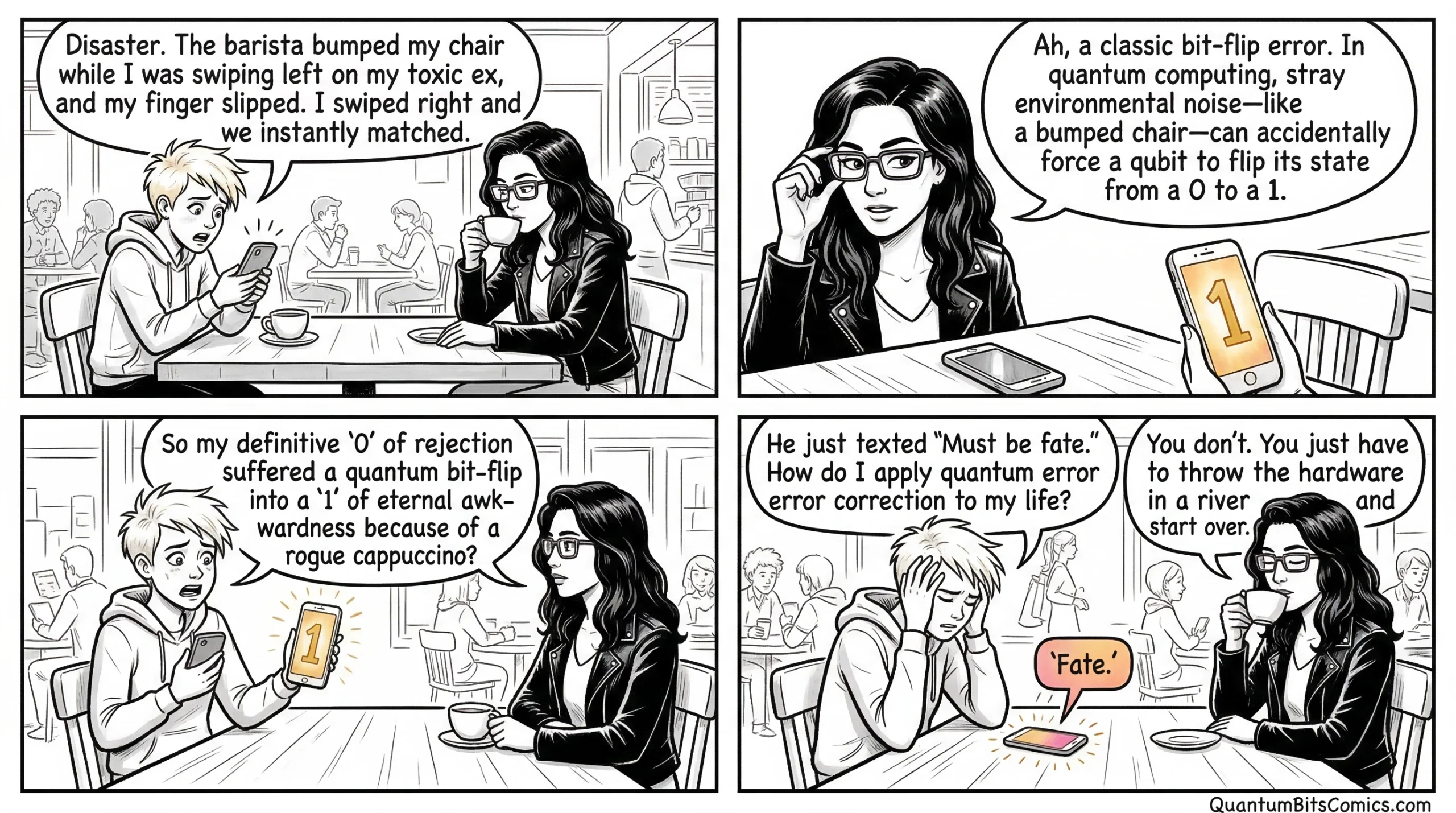
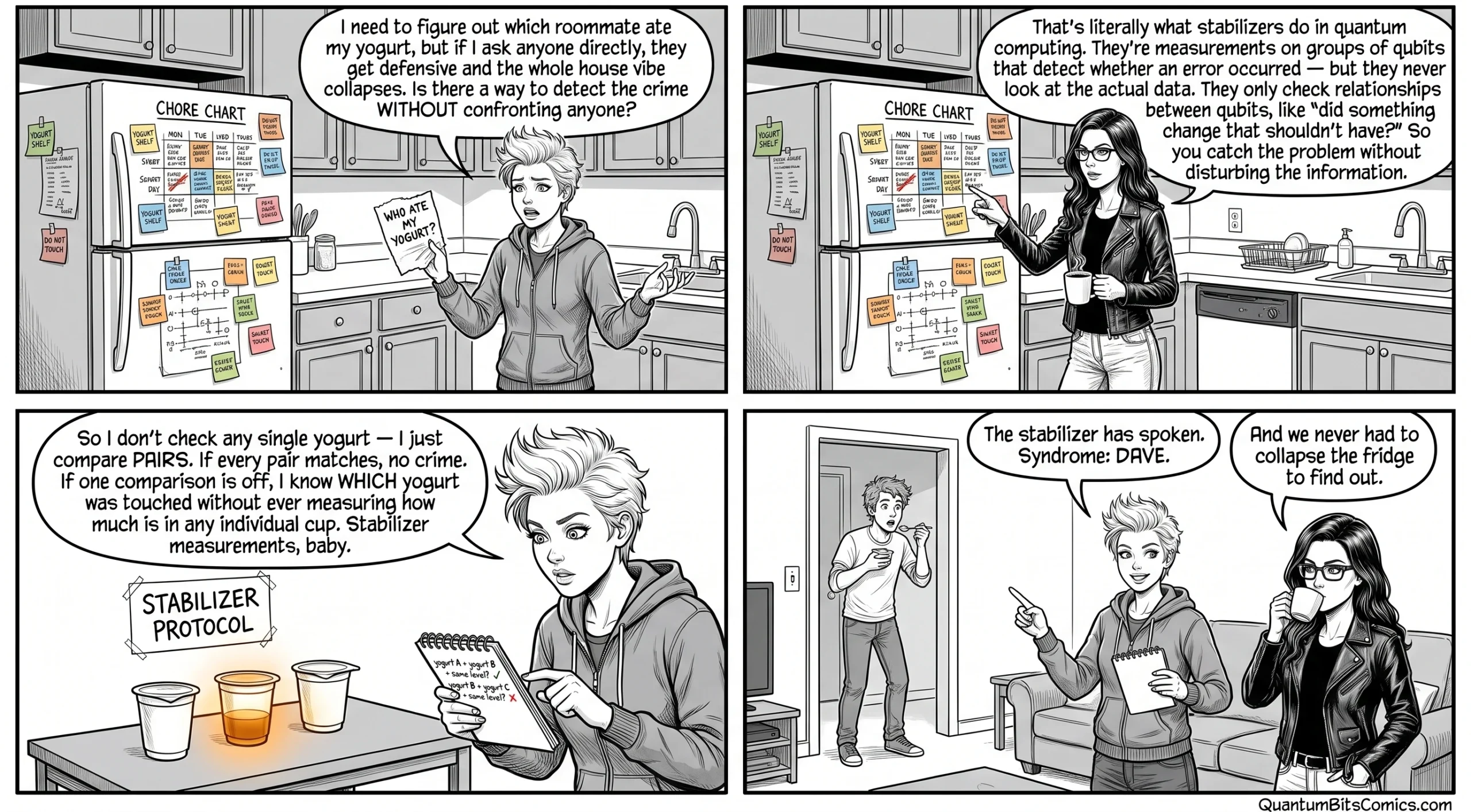
Fault Tolerant Computing

A quantum comic strip about fault tolerant computing

A fault-tolerant quantum computer is a machine that can perform arbitrarily long calculations even though its underlying components are unreliable. In a classical computer, transistors rarely fail, but quantum bits are entirely different. Regardless of the underlying hardware platform, physical qubits lose their quantum states quickly due to environmental noise and imperfect control pulses. Without a way to manage these errors, quantum calculations degrade into useless noise after just a few steps.

To achieve fault tolerance, physicists build protected units of information called logical qubits. A logical qubit is not a single physical object. It is a shared, entangled state distributed across tens, hundreds, or thousands of physical qubits. This distributed approach is necessary because the no-cloning theorem, a fundamental rule of quantum mechanics, forbids making a backup copy of an unknown quantum state. Instead, information is woven into the collective properties of a group. Through careful parity measurements that check relationships between qubits without reading their individual states, the system can detect and correct the errors.

Detecting an error is only part of the process. The operations used to check for errors can themselves introduce new errors. A system is fault-tolerant only if the error-correcting steps remove errors faster than they create them. This requirement defines the error threshold. If the physical hardware has an error rate below this specific mathematical limit, adding more physical qubits to each logical qubit will lower the overall logical error rate. If the hardware errors are above the threshold, adding more qubits simply creates a larger, messier problem.

The hardware industry is currently navigating the transition from noisy systems to early fault-tolerant machines. Researchers have successfully demonstrated the basic principles of logical qubits across multiple hardware platforms. Scaling these demonstrations to the millions of physical qubits needed for practical fault-tolerant computing remains the field’s central engineering challenge.

Subscribe on Substack at https://qubitguy.substack.com/
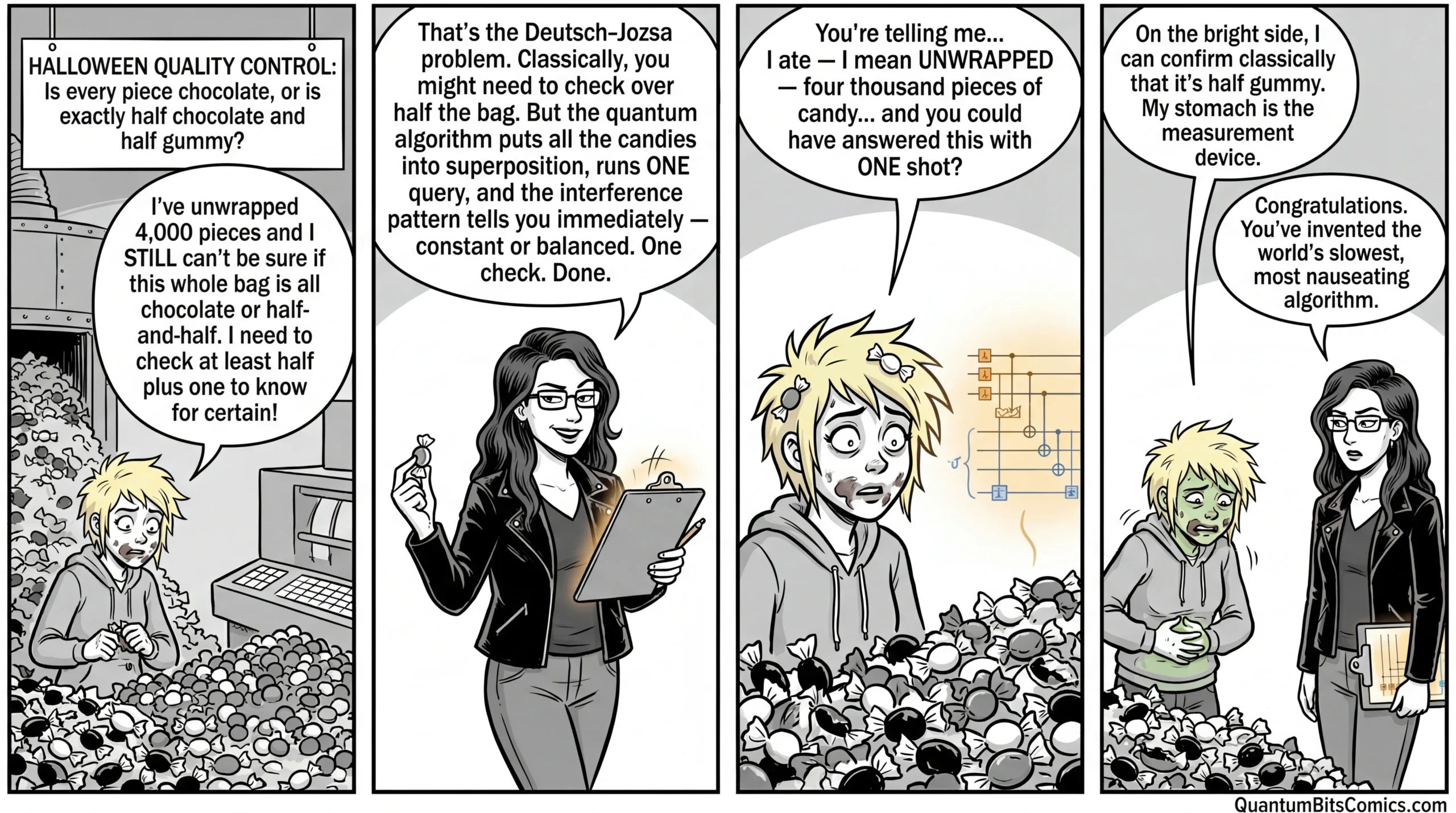
Laser Cooling

A quantum comic strip about laser cooling

Atoms at room temperature move at hundreds of meters per second, far too fast to serve as qubits. To use individual atoms for quantum computing, scientists must slow them almost to a standstill. Laser cooling is the primary technique for doing this.

The mechanism relies on the Doppler effect. A laser is tuned to a frequency slightly below an atom’s absorption resonance. An atom moving toward the laser beam sees the light blue-shifted into resonance, absorbs a photon, and receives a momentum kick in the opposite direction, slowing it down. An atom moving away from the beam sees the light red-shifted further from resonance and ignores it. The net effect: atoms moving in any direction get slowed, while while nearly stationary atoms experience minimal net force.

By arranging six laser beams in three perpendicular pairs (pointing inward from all directions), scientists create what is called optical molasses. Atoms caught in this intersection are slowed from every direction simultaneously. Temperatures below one millikelvin are routinely achieved, and more advanced techniques like Sisyphus cooling and evaporative cooling can push temperatures into the microkelvin and nanokelvin range.

Laser cooling is not unique to quantum computing. It earned Steven Chu, Claude Cohen-Tannoudji, and William Phillips the 1997 Nobel Prize in Physics, and it underpins atomic clocks, cold-atom physics experiments, and Bose-Einstein condensate research. In quantum computing, laser cooling is a prerequisite step for neutral-atom and trapped-ion platforms: atoms must be cold enough that their thermal motion does not disrupt gate operations or cause them to escape their traps.

The technique is mature and reliable. The remaining engineering challenges are about integration: combining laser cooling with optical trapping, Rydberg excitation, and readout in a single apparatus that can scale to thousands of atoms.

Subscribe on Substack at https://qubitguy.substack.com/

Quantum Key Distribution

A quantum comic strip about quantum key distribution

Quantum Key Distribution (QKD) is the most mature application of quantum cryptography. It solves a specific problem: allowing two parties to generate a shared secret key with a guarantee, based on physics, that no eavesdropper has a copy.

The best-known protocol, BB84, works like this. The sender transmits individual photons, each prepared with a specific polarization. Think of polarization like the orientation of a wave. In BB84, each photon is prepared in one of four orientations grouped into two pairs. Within each pair, the orientations are perpendicular: vertical versus horizontal, or diagonal-right versus diagonal-left.

The receiver measures each incoming photon to determine its polarization. The quantum mechanical constraint is this: to measure a photon’s polarization, you must choose which pair of orientations to check for. If a photon was prepared as vertical and you measure using the vertical/horizontal pair, you’ll correctly identify it as vertical. But if you measure that same vertical photon using the diagonal pair instead, you’ll get a random result.

Both sender and receiver randomly choose which pair to use for each photon. After transmission, they publicly announce their choices for each position (but not what they measured). They keep only the results where they happened to choose the same pair, forming their raw key.

The physics then provides the security. If an eavesdropper intercepted a photon to learn its polarization, they would face the same challenge: choosing which pair to measure with. When they guess wrong (which happens half the time), their measurement disturbs the photon. If they forward a replacement photon to avoid detection, it won’t always match the original. This introduces errors that the sender and receiver can detect by comparing a sample of their key bits. Too many errors means someone was listening, and they discard the key.

Subscribe on Substack at https://qubitguy.substack.com/
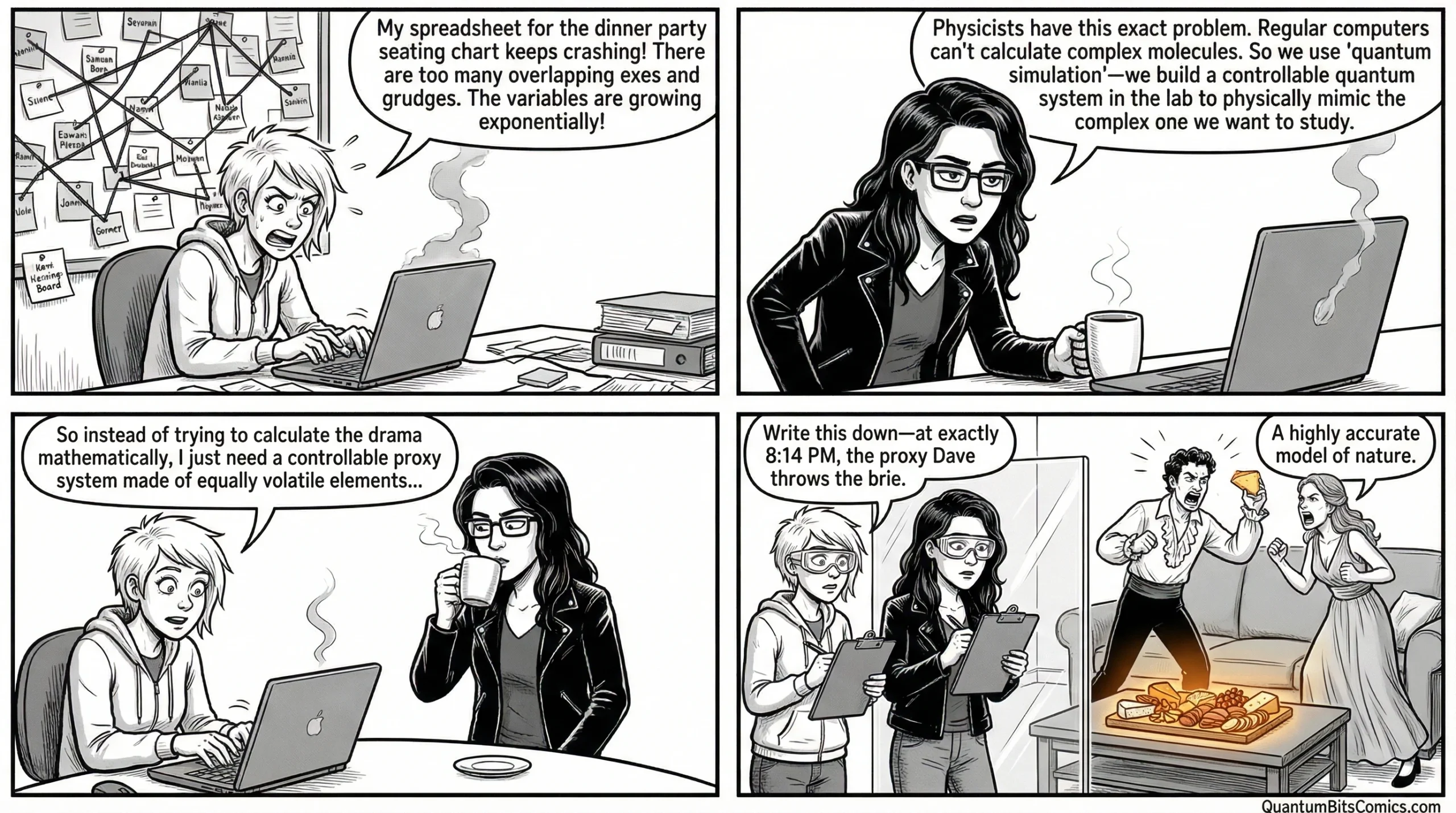
Y2Q

A quantum comic strip about y2q

Y2Q, “Years to Quantum,” refers to the estimated time remaining before a quantum computer capable of breaking widely deployed public-key cryptography becomes operational. It is a planning horizon, not a fixed date, and it drives urgency across government, finance, and technology sectors.

The threat is specific. RSA and elliptic-curve cryptography, which secure most internet traffic, rely on the computational difficulty of factoring large integers and computing discrete logarithms. Shor’s algorithm can solve both problems efficiently on a fault-tolerant quantum computer. No such machine exists today. Current processors are orders of magnitude too small and too error-prone to threaten real-world encryption keys. Estimates for when a cryptographically relevant quantum computer might be built range from ten to thirty years, with significant uncertainty.

The timeline matters now because of the “harvest now, decrypt later” threat. Adversaries can intercept and store encrypted communications today, then decrypt them once sufficiently powerful quantum hardware becomes available. Data with long-term sensitivity, such as government communications, medical records, and financial transactions, is already at risk even though the decryption capability does not yet exist.

This is why the migration to post-quantum cryptography has begun well ahead of Y2Q. NIST finalized its first post-quantum cryptographic standards in 2024, and major technology companies are integrating these algorithms into their infrastructure. The transition is complex, touching every layer of digital communication, and will take years to complete. Organizations that delay risk finding themselves exposed when the timeline, however uncertain, eventually arrives.

Subscribe on Substack at https://qubitguy.substack.com/
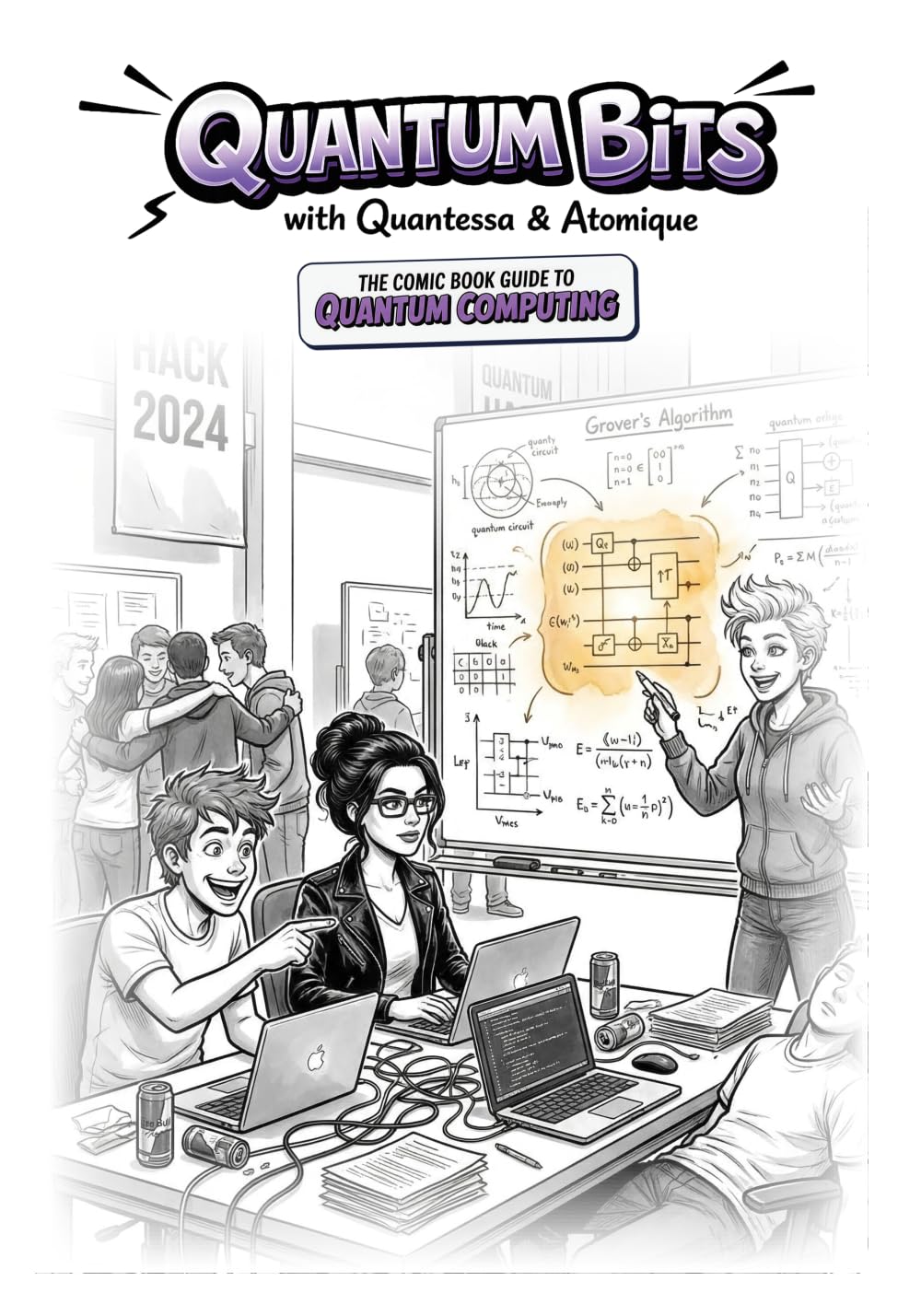
Quantum Phase Estimation

A quantum comic strip about quantum phase estimation

Quantum Phase Estimation (QPE) is an algorithm that extracts a hidden angle, called a phase, from a quantum operation. When certain quantum operations act on specific quantum states, they rotate those states by a characteristic angle. QPE determines what that angle is.

This matters because many important physical quantities correspond directly to these phases. The energy levels of a molecule, for example, are encoded as phases of the quantum operation that describes that molecule’s behavior. Finding these phases is equivalent to finding the energy levels, a task where classical computers struggle because the computational cost grows exponentially with the size of the molecule.

The algorithm works by applying the quantum operation in a controlled way across a set of auxiliary qubits, then using the Quantum Fourier Transform to convert the phase information into a measurement result. The more auxiliary qubits used, the more precisely the phase can be determined.

QPE is not just a standalone algorithm. It appears as a subroutine inside several major quantum algorithms. Shor’s algorithm uses it to extract periods in its factoring routine. Quantum chemistry algorithms use it to determine molecular energy levels. Quantum simulation algorithms use it to measure properties of physical systems.

The practical challenge is significant. QPE requires deep circuits running across many qubits, making it highly sensitive to hardware errors. Running it on problems beyond classical reach will require large-scale fault-tolerant quantum computers. Until that hardware matures, researchers are developing variational alternatives that approximate QPE’s results using shallower circuits better suited to near-term processors.

Subscribe on Substack at https://qubitguy.substack.com/